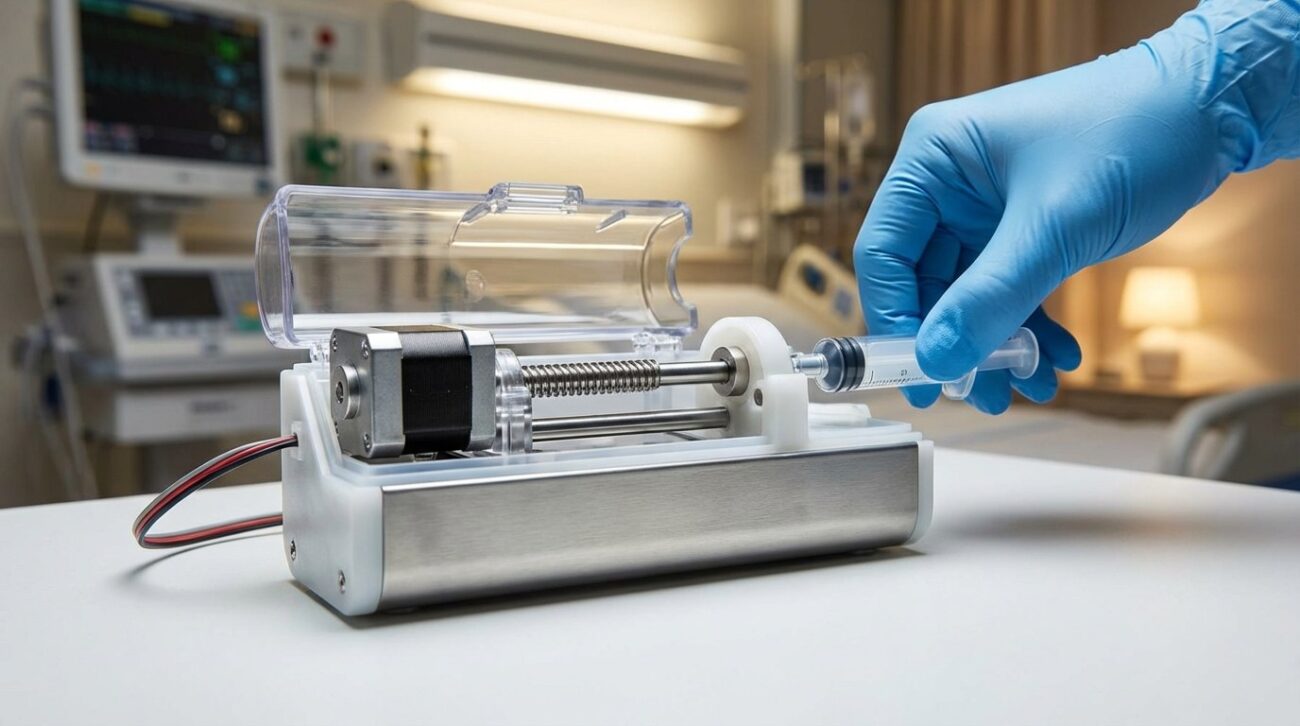
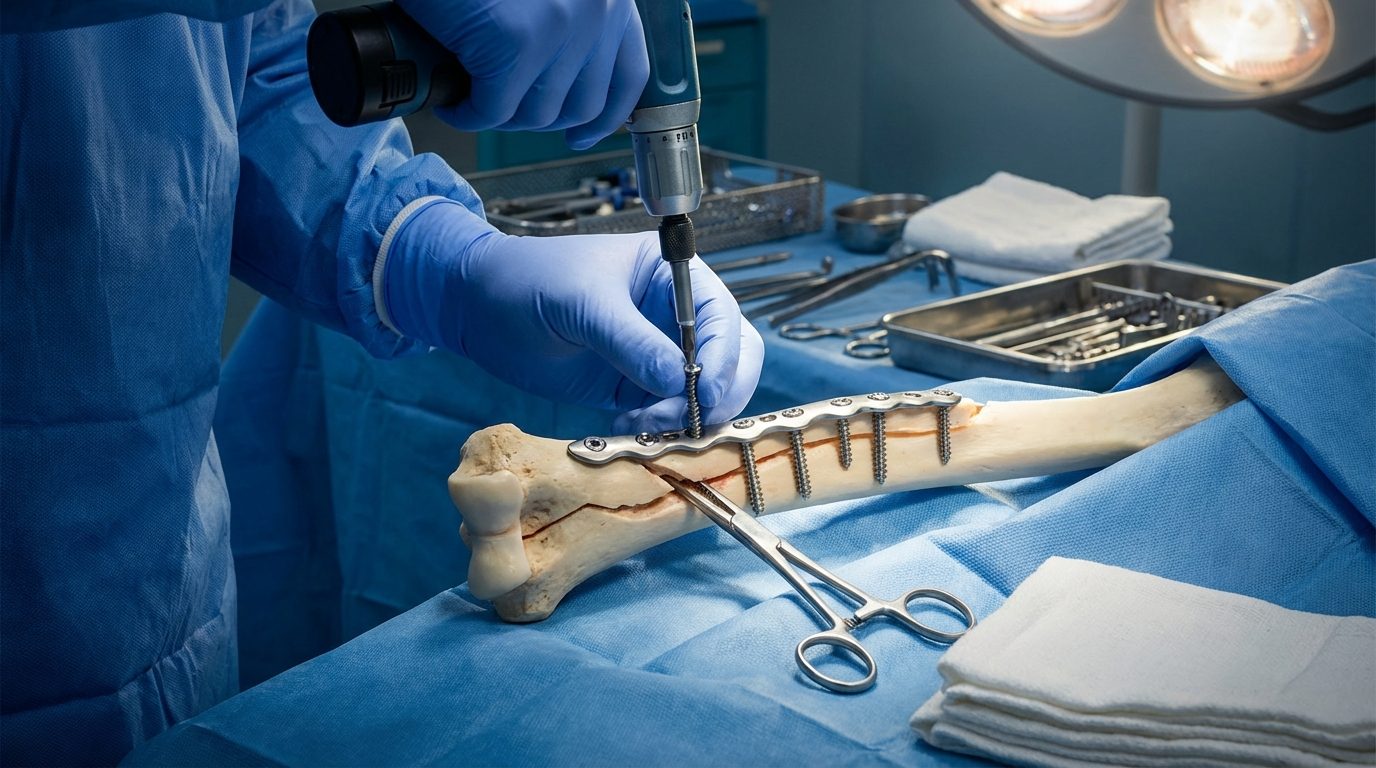

Orthopedic bone screws are among the most fundamental and critical implantable devices in internal fixation surgery. From simple cortical bone screws to structurally complex cancellous bone screws and pedicle screws, thread machining quality directly determines the reliability of fracture fixation. TC4 titanium alloy and 316L medical-grade stainless steel, as mainstream implant materials, present severe machining challenges due to their extremely low thermal conductivity and severe work hardening characteristics. Traditional single-point turning faces multiple challenges including uncontrolled tool tip temperature, surface chatter marks, and persistently high scrap rates. Micro external thread whirling, with its low-temperature advantage from interrupted cutting and rigid guide bushing support, has become the preferred solution for orthopedic bone screw thread machining.
What Are Orthopedic Bone Screws
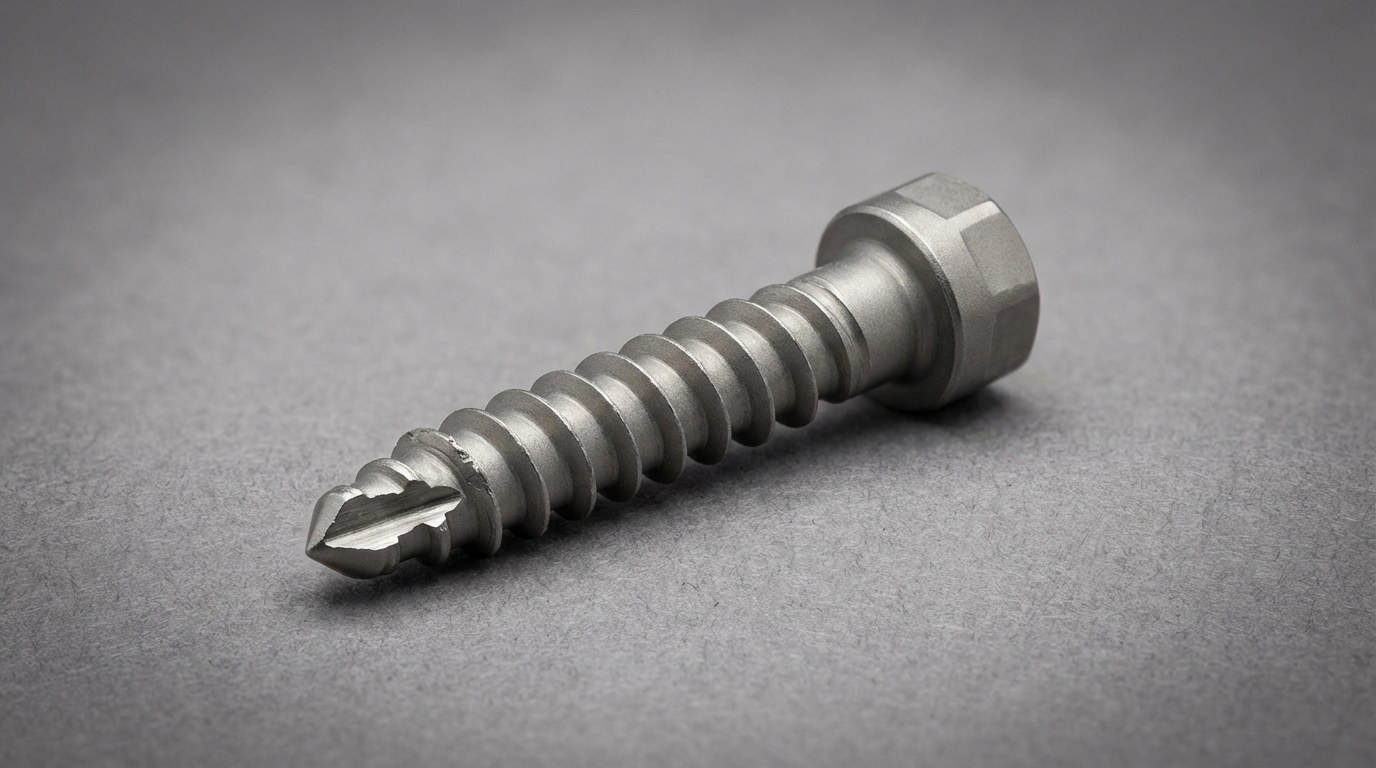
Orthopedic bone screws are titanium alloy or stainless steel threaded implants used in fracture internal fixation, spinal fusion, and bone and joint reconstruction surgeries. They achieve stable compression and secure fixation of fracture ends by screwing threads into bone tissue.
Application Scenarios
| Surgery Type | Typical Screw Specification | Fixation Site |
|---|---|---|
| Limb Fracture Internal Fixation | M3-M6 Cortical Bone Screw | Humerus, Radius, Tibia |
| Spinal Pedicle Fixation | M5-M8 Pedicle Screw | Cervical, Thoracic, Lumbar Spine |
| Hip Fracture Fixation | M6-M8 Cancellous Bone Screw | Femoral Neck, Intertrochanteric |
| Pelvis and Metaphysis | M4-M7 Cannulated Compression Screw | Pelvis, Ankle Joint |
Structural Characteristics
The thread structure of orthopedic bone screws is far more complex than standard mechanical threads, with the following distinctive features:
- Asymmetric tooth profile: Cancellous bone screws feature large-pitch deep tooth profiles, with thread cross-sections approaching rectangular or trapezoidal shapes to maximize bone tissue purchase
- Self-tapping cutting flutes: 1-2 axial cutting flutes are designed at the screw head, enabling automatic bone tissue cutting during insertion without pre-drilling and tapping
- Variable pitch design: Some compression screws adopt different pitches at the head and tail ends, achieving automatic fracture compression during insertion
- Surface treatment requirements: No cutting burrs or severe work-hardened layers are allowed on the machined surface after implantation; surface finish must reach Ra0.8 or better
Key Characteristics of Orthopedic Bone Screws
Thread machining for orthopedic bone screws must satisfy three core characteristics:
- Biomechanical strength: Thread root fillet radius must be strictly controlled (typically R0.2-0.4mm) to prevent stress concentration from causing fatigue fracture in vivo
- Bone tissue purchase force: Geometric parameters including thread major diameter, pitch, and thread angle directly determine the screw’s pull-out resistance in cancellous or cortical bone
- Surface integrity: The machined surface must be free of micro-cracks, folds, and severe work-hardened layers, which could become fatigue crack initiation sites in the body fluid environment
Orthopedic Bone Screw Thread Technical Parameters
| Parameter | Cortical Bone Screw | Cancellous Bone Screw | Pedicle Screw |
|---|---|---|---|
| Thread Specification | M3-M5 | M4-M7 | M5-M8 |
| Pitch | 0.8-1.25mm | 1.5-2.75mm | 2.5-3.5mm |
| Accuracy Class | 4H | 4H | 4H |
| Surface Roughness | Ra0.4-0.8 | Ra0.8-1.6 | Ra0.8-1.6 |
| Thread Root Radius | R0.15-0.25mm | R0.25-0.4mm | R0.3-0.5mm |
| Material Standard | ASTM F136 (TC4) / ASTM F138 (316L) | ASTM F136 (TC4) | ASTM F136 (TC4) |
| Cycle Time (Whirling) | 20-30 sec | 25-40 sec | 35-50 sec |
| Inspection Standard | ISO 5835 / GB/T 2280 | ISO 6475 | ASTM F1665 |
Why Thread Whirling Is the Preferred Process for Orthopedic Bone Screws
Core Pain Points of Traditional Turning
| Pain Point | Specific Manifestation | Consequence |
|---|---|---|
| Uncontrolled Cutting Heat | TC4 thermal conductivity is only 1/6 of 45 steel; turning tool tip temperature exceeds 1000°C | Tool life only 10-20 pieces; frequent tool changes severely reduce capacity |
| Work Hardening | Continuous turning sharply increases machined surface hardness | Subsequent pass tool wear increases exponentially; dimensional accuracy drifts |
| Built-Up Edge | Titanium alloy strongly affinitive with tool materials at high temperatures | Severe tool adhesion marks on thread surface; fails implant standards |
| Chatter and Deflection | Large radial turning force bends slender screws | Thread pitch diameter shows “large-ends-small-middle” taper error; high scrap rate |
Core Advantages of Thread Whirling
| Comparison | Traditional CNC Turning | Micro External Thread Whirling |
|---|---|---|
| Cycle Time | 3-5 minutes (multiple passes) | 20-40 seconds (single pass) |
| Insert Life | 10-20 pieces/edge | 800-1,500 pieces/edge |
| Surface Roughness | Ra1.6-3.2 (requires secondary polishing) | Ra0.4-0.8 (polishing-free) |
| Scrap Rate | 8-15% | 0.3-1% |
| Tooth Profile Consistency | Depends on operator skill, high variation | CNC program controlled, consistency >99.5% |
Three Core Advantages
- Interrupted cutting achieves true low-temperature machining: Whirling inserts contact the workpiece only about 30% of each cutting cycle, with the remaining 70% cooling in air. Cutting zone temperature is 200-300°C lower than continuous turning, fundamentally eliminating TC4 work hardening and tool burnout
- Guide bushing rigid support eliminates deflection: The Swiss-type lathe guide bushing contacts the whirling cutting point directly, absorbing cutting forces perfectly. Even pedicle screws with length-to-diameter ratios exceeding 10:1 maintain perfect straightness
- Single-pass forming ensures thread consistency: Multiple inserts participate in envelope cutting simultaneously, each removing minimal material. Work-hardened layer depth is controlled within 0.01mm. Tooth profile accuracy is determined by CNC programs rather than operator experience
Orthopedic Bone Screw Thread Machining Process
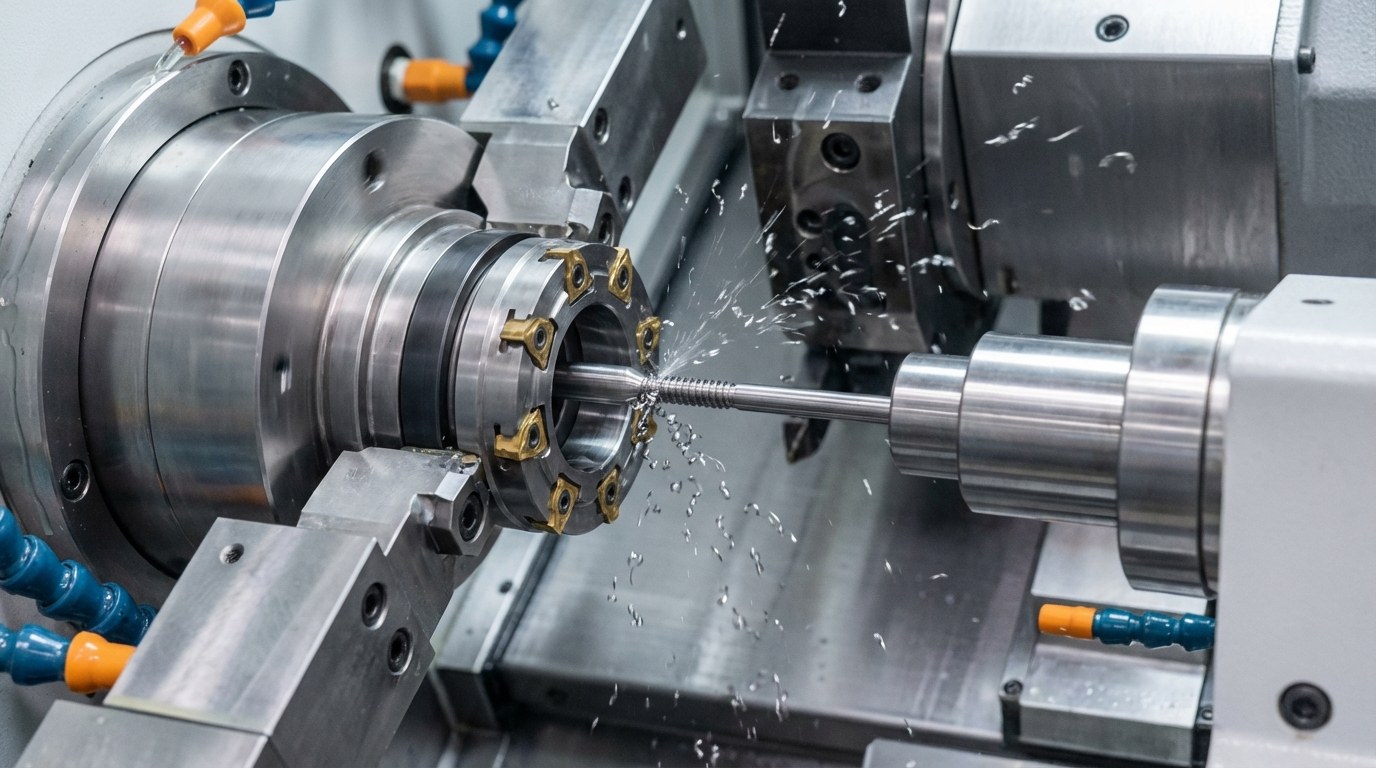
The complete orthopedic bone screw thread machining process consists of the following 8 steps:
| Step No. | Process Name | Machining Content | Equipment/Tooling |
|---|---|---|---|
| 01 | Material Feeding | TC4/316L bar stock cut to length, end chamfer | Swiss-type lathe auto-feeder |
| 02 | Rough Turning | Turn screw shaft and head outer diameter, leave 0.1mm finish allowance | Swiss-type lathe carbide turning tool |
| 03 | Center Drilling | Drill central through-hole for cannulated screws (skip for solid screws) | Swiss-type lathe gun drill |
| 04 | Head Forming | Turn screw head geometry (spherical/flat/hex socket) | Swiss-type lathe form tools |
| 05 | Finish Turning | Finish turn thread section OD to final pitch diameter | Swiss-type lathe finish turning insert |
| 06 | Thread Whirling | Micro external whirling single-pass complete thread profile | Swiss-type lathe + whirling attachment |
| 07 | Deburring | Remove thread end burrs, clean drive socket | Mechanical chamfer + ultrasonic cleaning |
| 08 | Full Inspection | Pitch diameter, pitch, thread angle, roughness, visual 100% inspection | CMM + GO/NO-GO gauges + roughness tester |
Step 1: Material Feeding
TC4 titanium alloy or 316L stainless steel bar stock is automatically fed through the Swiss-type lathe guide bushing and cut to length by the parting tool. The cut end face must maintain perpendicularity to the axis within 0.02mm, with cut length tolerance controlled at ±0.1mm. Bar stock surface quality must reach ground grade (Ra0.8) to prevent surface defects from being carried into the final thread area.
Step 2: Rough Turning
Carbide turning tools rough-turn the screw shaft and head outer diameter. For TC4 material, cutting speed is controlled at 60-80m/min, with 0.3-0.5mm feed per pass, leaving 0.1mm finish allowance. Post-rough-turn OD cylindricity must be controlled within 0.02mm. The key to this process is controlling cutting heat, requiring generous coolant flow.
Step 3: Center Drilling
For cannulated compression screws, a dedicated gun drill creates the central through-hole along the axis. TC4 drilling recommends 2000-3000rpm spindle speed, 0.02-0.05mm/r feed rate, with high-pressure internal coolant (80bar+) for chip evacuation. Hole diameter tolerance is controlled within ±0.05mm, with hole wall roughness Ra1.6 or better. Solid cortical bone screws skip this step.
Step 4: Head Forming
Form turning tools machine the screw head geometry. Depending on product type, the head may be spherical, flat countersunk, or stepped, while simultaneously machining the cross slot, hex socket, or torx drive. Drive socket dimensional accuracy directly affects torque transmission efficiency during surgical insertion.
Step 5: Finish Turning
Finish turn the thread section outer diameter to final dimensions. TC4 finish turning uses 80-100m/min cutting speed, 0.05-0.1mm/r feed rate, with post-finish OD tolerance controlled within ±0.01mm, cylindricity 0.005mm, and surface roughness Ra0.8. Finish allowance must be uniform; otherwise, thread depth variation will occur during whirling.
Step 6: Thread Whirling (Core Process)
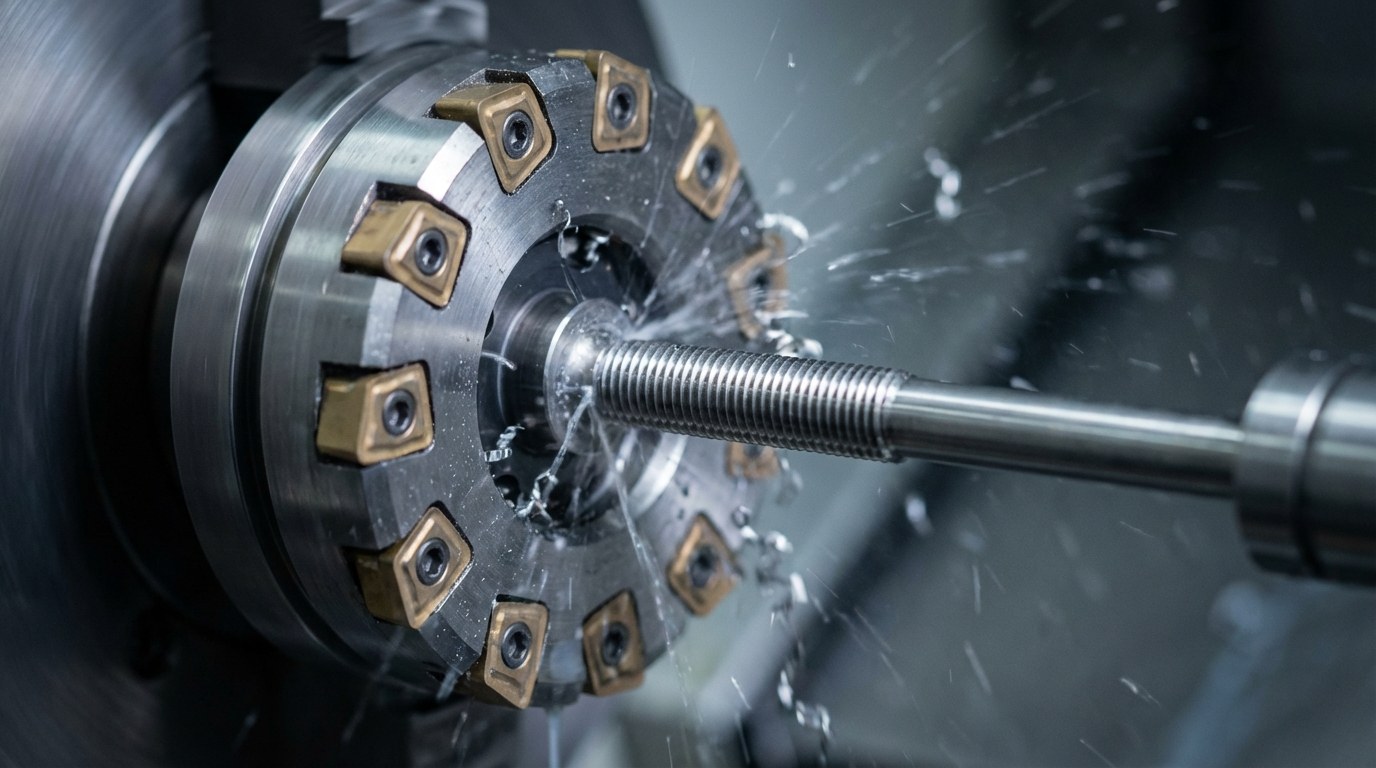
The whirling attachment is mounted on the Swiss-type lathe tool post, with the cutter head positioned immediately adjacent to the guide bushing face (<1mm distance) for eccentric rotary cutting.
- Attachment speed: 4,000-6,000 rpm
- Spindle speed (C-axis): 15-30 rpm
- Feed rate: 0.1-0.2 mm/r
- Depth of cut: Single-pass forming (depth equals thread height)
- Cooling: High-pressure internal/external cooling, 80-120 bar oil-based cutting fluid
- Inserts: 3-6 uncoated ultra-fine grain carbide custom inserts, tooth profile customized per product drawing
This single-pass operation envelopes the complete thread profile, including complex geometric features such as self-tapping flutes and variable pitch sections, all achievable through C-axis speed variation and Z-axis interpolation.
Step 7: Deburring
Medical implants have zero tolerance for burrs. Dedicated mechanical chamfering tools remove thread start and end burrs, followed by ultrasonic cleaning to remove fine chip residue. For drive socket interiors, miniature nylon brushes with cleaning solution are used for precision cleaning. The final surface must show no visible burrs, metal chips, or cutting fluid residue under 10x magnification.
Step 8: Full Inspection
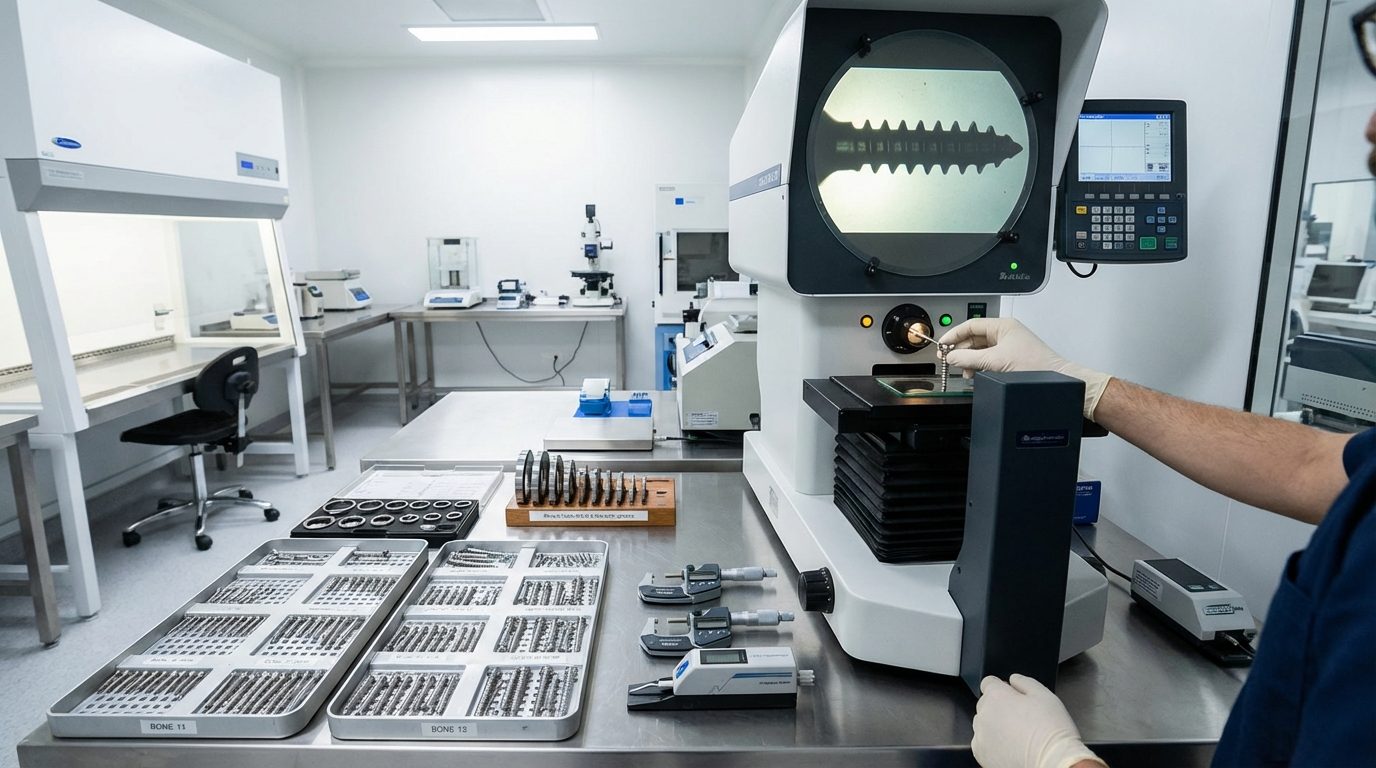
Orthopedic bone screws undergo 100% full inspection, covering the following items:
- Thread pitch diameter: CMM measurement, tolerance per 4H class
- Cumulative pitch error: No more than ±0.01mm over 300mm length
- Thread angle: Profile projector measurement, error no more than ±15′
- Thread root radius: Profilometer measurement, R-value deviation no more than ±0.05mm
- Surface roughness: Roughness tester sampling, Ra values per product specification
- Visual: No burrs, cracks, folds, or tool marks under 10x magnification
Machining Challenges and Solutions
Challenge 1: Rapid Tool Wear from TC4 Work Hardening
After TC4 cutting, the machined surface hardness can reach 2-3 times the base material hardness. Traditional turning with multiple passes forces subsequent cutting edges to constantly machine on high-hardness surfaces, causing tool life to drop precipitously. Thread whirling eliminates the multiple-pass problem entirely through single-pass forming. The work-hardened layer from interrupted cutting is only 0.01-0.02mm deep, far less than turning’s 0.1-0.2mm. Combined with uncoated ultra-fine grain carbide inserts and 120bar high-pressure oil-based cutting fluid, single insert life can stably reach 800-1,500 pieces.
Challenge 2: Intersection of Self-Tapping Flutes and Threads
Cancellous bone screws and some cortical bone screws require 1-2 axial self-tapping cutting flutes at the screw head. The intersection of cutting flutes with threads is highly prone to burrs and micro-cracks. The solution is to complete the cutting flute milling before thread whirling, allowing the whirling cut to naturally blend the sharp intersection edges. If cutting flutes are located at the thread tail end, dedicated form tools perform precision finishing after whirling to ensure smooth transition at intersection areas without burrs.
Manufacturing Case Study
Customer Background
A leading domestic orthopedic implant manufacturer with annual capacity exceeding 2 million bone screws, covering three major product lines: cortical bone screws, cancellous bone screws, and pedicle screws. The original production line used imported Swiss-type lathes with single-point thread chasing.
Technical Challenges
- TC4 titanium alloy turning insert life only 10-15 pieces, monthly tooling cost exceeding 80,000 RMB
- Cancellous bone screw deep thread turning scrap rate as high as 12%, with 30 RMB scrap cost per piece
- Production line cycle time unable to meet peak season demand, urgent capacity expansion needed
Solution
| Improvement Item | Before | After |
|---|---|---|
| Thread Machining Process | Swiss-type single-point chasing | Swiss-type + micro whirling attachment |
| Tooling Type | Custom form turning tools | Ultra-fine grain carbide whirling inserts |
| Cooling Method | Standard external coolant | 100bar high-pressure internal coolant |
| Thread Accuracy | Operator-dependent adjustment | CNC program single-pass forming |
Implementation Results
The project achieved significant benefits after implementation:
- 80x insert life improvement: Single insert life increased from 10-15 to 800-1,200 pieces, reducing monthly tooling cost from 80,000 to 6,000 RMB
- Dramatic scrap rate reduction: Cancellous bone screw scrap rate dropped from 12% to below 0.5%, saving approximately 700,000 RMB annually in quality losses
- 6x capacity increase: Per-piece cycle time reduced from 3 minutes to 28 seconds, increasing monthly capacity from 500,000 to 3,000,000 pieces with the same equipment count
- Surface quality upgrade: Thread surface roughness improved from Ra1.6-3.2 to Ra0.4-0.8, eliminating the secondary polishing process
Customer Feedback
“Thread whirling has been a qualitative leap for our orthopedic bone screw production. The most immediate impact was the dramatic drop in scrap rates — cancellous bone screw scrap rates that used to give us headaches are now consistently below 0.5%. The insert life improvement was even more surprising — we used to change tools weekly, now once a month is enough.”
Common Questions
Q1: Why must orthopedic bone screws use thread whirling instead of conventional turning?
During conventional single-point turning of TC4 titanium alloy, tool tip temperature exceeds 1000°C, causing severe work hardening and built-up edges, resulting in thread surface quality that cannot meet ASTM F136 standard requirements. Whirlwind milling interrupted cutting gives each insert 70% cooling time per cutting cycle, with cutting temperature 200-300°C lower than turning. Single insert life increases 60-80x, achieving 4H precision and Ra0.4 surface roughness in a single pass.
Q2: Can whirlwind milling machine variable-pitch compression screws?
Yes. The Swiss-type lathe C-axis (spindle) speed and Z-axis feed rate are linked through macro program control. Compression screws with different head and tail pitches can be machined in one clamping by dynamically adjusting the C-axis to Z-axis speed ratio during whirling, producing complete variable-pitch threads with smooth, step-free pitch transitions.
Q3: What is the per-piece machining cost for orthopedic bone screws?
Taking an M6 cortical bone screw as an example, the whirling process per-piece cost is approximately: material ¥0.8 + tooling consumables ¥0.05 + equipment depreciation ¥0.3 + labor ¥0.2 + inspection ¥0.15 = total approximately ¥1.5/piece. Compared to conventional turning at ¥2.5-3/piece, overall cost is reduced by 40-50%.
Q4: Does the central drilling of cannulated screws affect whirling thread quality?
After center drilling, the tube wall becomes thinner and rigidity further decreases. This is exactly where whirling milling excels — the guide bushing provides rigid support directly adjacent to the cutting point, and cutting forces are centripetally balanced. The drilled thin wall will not deform during whirling. However, internal burrs must be thoroughly cleaned after drilling, otherwise chip re-entry may occur during whirling.
Q5: What are the differences in whirling parameters between 316L stainless steel and TC4 titanium alloy screws?
316L requires 15-20% lower cutting speed than TC4 due to more severe work hardening and stronger tool adhesion. TC4 whirling attachment speed is 4000-6000rpm, while 316L is recommended at 3500-5000rpm. For coolant, 316L requires higher-lubricity oil-based cutting fluid to suppress built-up edges. For insert selection, TC4 can use TiAlN-coated inserts, while 316L is recommended with uncoated ultra-fine grain inserts to avoid coating delamination.
Q6: Can whirlwind-milled bone screws pass FDA or NMPA registration inspection?
Yes. Whirlwind-milled thread precision (4H grade), surface roughness (Ra0.4-0.8), and surface integrity all exceed conventional turning results, fully meeting ISO 5835, ISO 6475, and ASTM F1665 product standard requirements. Multiple implant manufacturers using whirlwind milling have successfully passed NMPA registration and FDA 510(k) certification.
Summary
Thread machining for orthopedic bone screws is one of the most technically demanding and quality-critical process steps in medical device manufacturing. The difficult-to-machine characteristics of TC4 titanium alloy and 316L medical-grade stainless steel make conventional single-point turning unable to meet mass production demands in efficiency, cost, and quality. Micro external thread whirling, with its low-temperature advantage from interrupted cutting, zero-deformation characteristics from guide bushing rigid support, and high-precision consistency from single-pass forming, has become the preferred process solution for orthopedic bone screw thread machining. For orthopedic implant manufacturers with annual production exceeding 500,000 pieces, the comprehensive cost advantage of whirling is particularly significant, with typical ROI within 6-12 months.
If you are facing orthopedic bone screw machining challenges (such as TC4 tool life, 316L work hardening, thin-wall cannulated screw deformation), or looking to improve production efficiency and reduce costs, contact us for customized solutions.